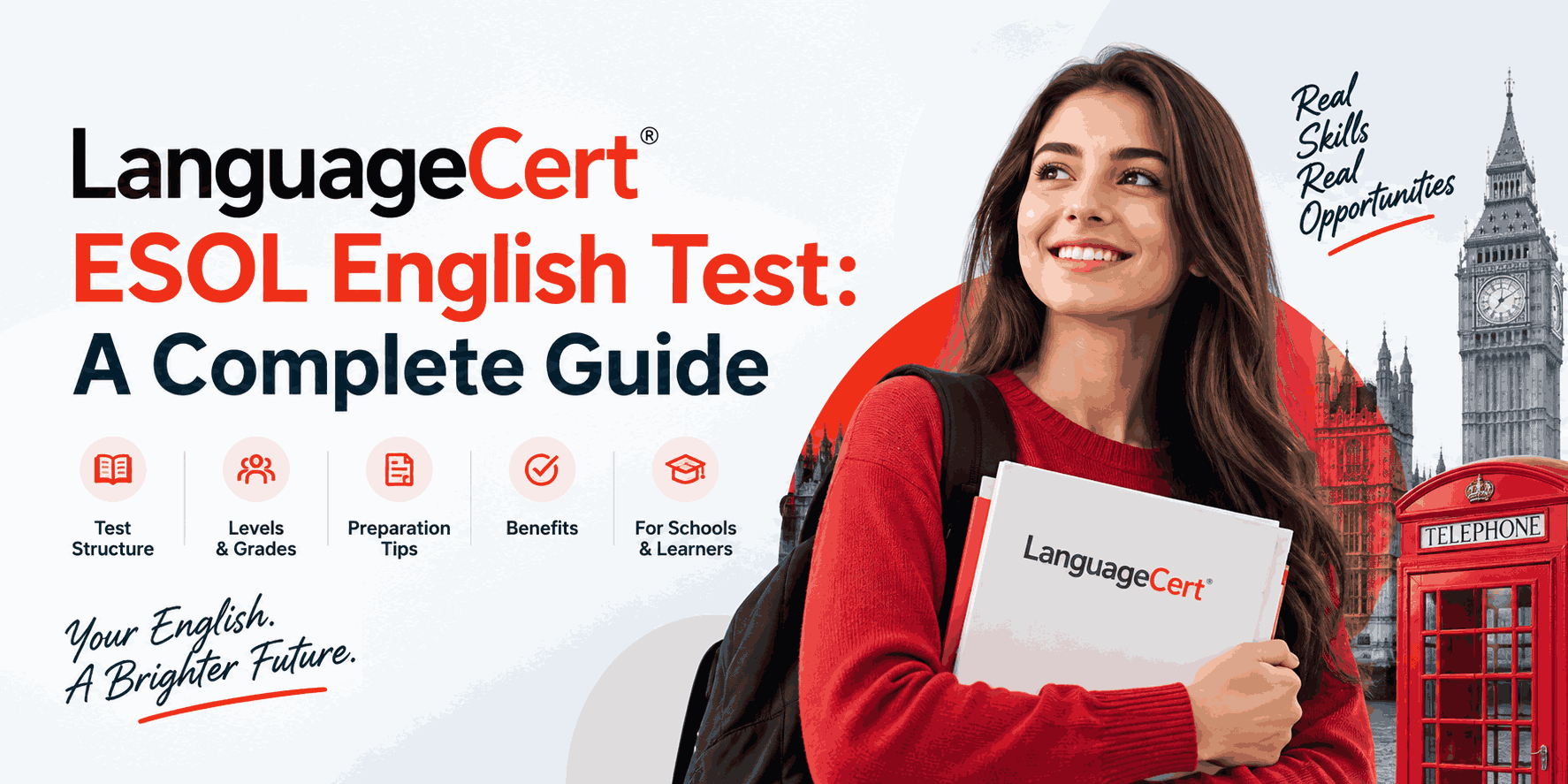
The LanguageCert ESOL English Test by LanguageCert is a globally recognized exam that checks your English skills from basic to advanced levels (A1–C2).
The test is designed to assess real-life English in speaking, listening, reading, and writing, making it suitable for learners at every stage.
In this blog, you’ll get a simple overview of all levels, prices, and key details you need before taking the exam.
LanguageCert ESOL English Exams
1. LanguageCert ESOL A1 Preliminary
Written Exam
- Listening: Understanding short audio recordings, matching information, choosing correct responses, following simple conversations, and completing missing words.
- Reading: Understanding basic written texts through gap-fill questions, multiple-choice answers, text matching, and short comprehension tasks.
- Writing: Completing two short tasks, such as writing a letter and a message, postcard, or note (each 30–50 words).
Speaking Exam
- Introducing yourself and answering basic questions
- Short conversations with the examiner
- Comparing simple pictures
- Speaking on a topic for 1 minute with follow-up questions
2. LanguageCert ESOL A2 Access
Written Exam
- Listening: Understanding short recordings, matching sentences, words, or symbols, selecting correct responses, following simple conversations, and identifying specific information from short talks.
- Reading: Understanding simple texts through gap-fill questions, multiple-choice questions, text completion tasks, and short comprehension exercises.
- Writing: Completing two short tasks, such as writing a letter and a short message, postcard, or note.
Speaking Exam
- Giving and spelling your name and stating your country of origin
- Answering basic personal questions
- Responding to everyday situations and initiating simple interaction
- Comparing pictures and identifying similarities and differences
- Speaking on a topic for 1 minute with preparation time and follow-up questions
3. LanguageCert ESOL B1 Achiever
Written Exam
- Listening: Understanding short conversations and discussions between speakers, identifying main ideas, purpose, context, opinions, attitudes, and specific details, including short note-taking tasks.
- Reading: Understanding different text types such as emails, articles, adverts, and continuous texts.
- Writing: Producing two written tasks: A formal response (70–100 words) based on given information such as letters, posters, or notices and an informal letter (100–120 words) on a personal topic including specific functions like inviting or describing plans
Speaking Exam
The speaking test includes simple real-life interaction tasks such as:
- Giving and spelling your name and stating your country of origin
- Answering basic personal questions
- Responding to everyday situations and initiating simple interaction
- Comparing pictures and identifying similarities and differences
- Speaking on a topic for 1 minute with preparation time and follow-up questions
4. LanguageCert ESOL B2 Communicator
Written Exam
- Listening: Understanding unfinished conversations and longer spoken texts such as radio broadcasts, presentations, and discussions.
- Reading: Understanding a range of longer texts such as news stories, articles, reviews, and proposals.
- Writing: Producing two written tasks such as a formal response (100–150 words) for a public audience based on specific content points and an informal piece (150–200 words), such as a letter, story, or descriptive composition.
Speaking Exam
- Giving and spelling your name, stating your country of origin, and answering personal questions
- Responding to 2–3 real-life situations and initiating interaction
- Taking part in a discussion to make plans or decisions using written prompts
- Speaking on a topic for 2 minutes after 30 seconds preparation, followed by follow-up questions
5. LanguageCert ESOL C1 Expert
Written Exam
- Listening: Understanding complex conversations and spoken texts that include idiomatic expressions, tone shifts, opinions, and attitudes.
- Reading: Understanding advanced texts such as academic passages, arguments, and opinion-based writing.
- Writing: Producing two written tasks like a formal response (150–200 words) such as a letter, report, article, or argument using written or visual input and expressing opinions, justification, and analysis and an informal or semi-formal composition (250–300 words) such as a letter, story, or descriptive piece requiring persuasion, evaluation, and hypothesis
Speaking Exam
- Giving and spelling your name, stating your country of origin, and answering personal questions
- Responding to 2–3 real-life situations and initiating interaction
- Taking part in a structured discussion to plan or decide something using written prompts
Speaking on a topic for 2 minutes after 30 seconds preparation, followed by examiner questions
6. LanguageCert ESOL C2 Mastery
- Listening: Understanding highly advanced spoken English including idiomatic expressions, colloquialisms, tone shifts, and complex attitudes.
- Reading: Understanding complex texts such as academic, argumentative, and opinion-based material.
- Writing: Producing two highly advanced written tasks like a formal response (200–250 words) such as a letter, report, article or an extended informal composition (250–300 words) such as a story, letter, or descriptive text requiring persuasion, hypothesis, and strong opinion expression.
Speaking Exam
- Giving and spelling your name, stating your country of origin, and answering personal questions
- Responding to 2–3 real-life situations and initiating interaction
- Taking part in a structured discussion to plan or decide something using written prompts
- Speaking on a topic for 3 minutes after 30 seconds preparation, followed by examiner questions.
Final Verdict
Overall, these exams provide a structured way to measure English ability across all levels, with clear tasks and well-defined assessment criteria.
Each stage becomes more detailed and skill-focused as learners progress. This makes it easier to track improvement and choose the right level based on personal goals.